
Invoice Discounting Cash Flow Forecast: Why the Standard Approach Breaks (and What to Do Instead)
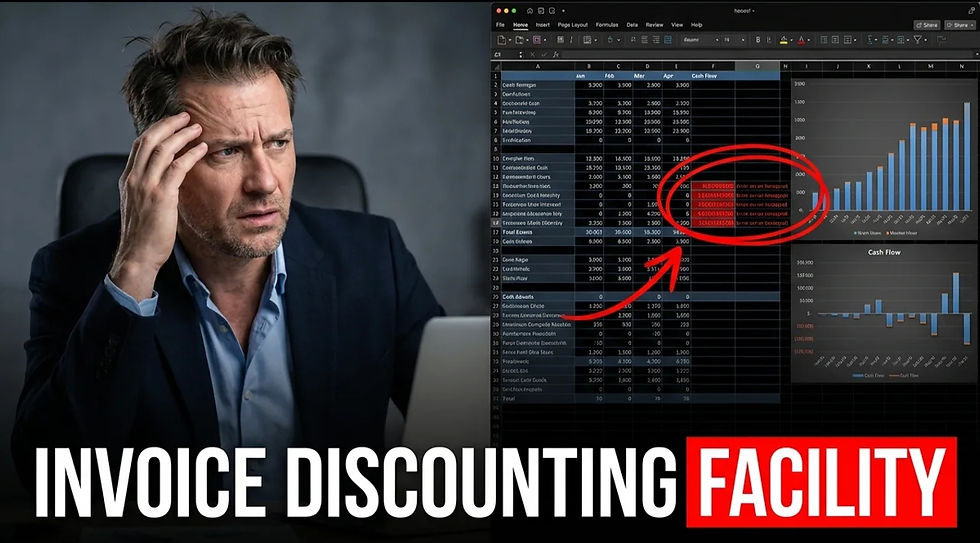
Invoice discounting facilities are common, especially in businesses with long payment cycles and healthy order books. But in my experience, the cash flow forecasting behind them is almost always either wrong, manual, or both. Here's why, and what to do instead.
Why standard cash flow forecasting doesn't work with invoice discounting
When I build a 13-week cash flow forecast for a business with standard accounts receivable, the approach is straightforward. You look at the due dates on outstanding invoices and use those as your expected cash inflow timing. If a customer tends to pay late, you adjust. If invoices are overdue, you override. It's not complicated.
Factoring is slightly different, but still manageable. You're essentially selling your invoices to a third party and getting paid almost immediately. So instead of using the invoice due date, you use the invoice date plus a day or two. You flag which invoices are being factored, and you know roughly when the cash lands. Easy enough.
Invoice discounting is a different beast entirely.
With an invoice discounting facility (IDF), you're not selling your invoices. You're using them as security against a revolving credit line. And that one distinction changes everything about how your forecast needs to work.
How an invoice discounting facility actually works
Here's the mechanics:
You raise invoices to your customers
You upload those invoices to your IDF provider
That increases the amount you can draw down from the facility
You draw down cash when you need it
When your customers pay, that money goes directly to the IDF provider, freeing up the facility again
The critical word is draw down. The timing of cash hitting your bank account is no longer tied to when your customer pays, or even when you issue the invoice. It's tied to when you decide to pull cash from the facility. And that's a discretionary decision, not a predictable event.
This means forecasting customer cash inflows in the traditional way becomes almost meaningless. Your customers are paying the IDF provider, not you. Your bank balance, modelled in isolation, will keep going negative because you're not receiving cash from customers directly. If your forecast shows that and you panic, you're looking at the wrong number.
Building an invoice discounting cash flow forecast that actually works
The shift that makes this work is moving away from "when is cash coming in from customers" and towards "what is my total available liquidity at any point in time."
Total available liquidity = cash in the bank + available headroom in the IDF facility.
Once you accept that framing, the forecast becomes logical again. Your cash balance goes down, your facility headroom goes up, and you draw down from the facility in the weeks where you'd otherwise have a shortfall. That's how liquidity management actually works here.
To model the facility balance correctly, you need to track two things.
Invoices going into the facility. Every invoice you raise and submit increases your available headroom. For current invoices, you know the dates. For future invoices, you need a proxy. The best one I've found is expected shipment dates from your sales order book. Shipment date plus one or two days gives you an approximate invoice date, and that becomes the date the invoice enters the facility.
Cash collected by the IDF provider. When your customers pay, the money goes to the IDF provider. That repayment frees up the facility. So you need to model expected customer payment dates too, because that tells you how the facility availability moves over time.
Once you have both feeding into your model, you can see the facility balance across the full forecast horizon, usually 13 weeks out. You can see which weeks you're likely to have a genuine cash shortfall, and therefore which weeks you'd draw down. You can also check whether you're raising enough invoices to always have sufficient headroom to cover those shortfalls when they arrive.
That last point matters more than most people realise. Your IDF facility has a limit. If you've drawn it down and your customers haven't paid yet, you can't draw more. A proper invoice discounting cash flow forecast tells you that's coming weeks in advance, not when the draw-down request gets rejected.
It's also worth modelling the facility rules explicitly. Concentration limits, credit limits, eligibility rules around aged debt. These aren't edge cases. They're the things that catch businesses out, and they should be built into the model so you can see a potential breach on the horizon and act before it happens. This is what practitioners call the 13WCF discipline applied to a more complex liquidity structure.
What this looked like in practice
On the project I just finished, the CFO was managing everything manually across three separate spreadsheets. The cash flow forecast. An upload log for invoices going into the facility. A tracker for collections coming back from customers. Nothing was linked. Updating everything was eating a meaningful chunk of his week, and the picture it gave him was still fuzzy.
We replaced all of it with a single model. One tab served as a running audit trail of invoices submitted to the facility. Another tracked collections. Both fed directly into the main cash flow model, and the IDF facility balance updated automatically as inputs changed.
We also built the credit limit into the model, so the forecast would flag any week where the available headroom was at risk of hitting the ceiling. That forward visibility is the whole point of 13WEEKS-style cash forecasting: not to tell you what just happened, but to give you enough runway to act before things go wrong.
I saved the CFO several hours a week. More importantly, he finally had a single, coherent view of his cash position that he could trust.
The question worth asking yourself
If your business has an invoice discounting facility, ask yourself this: does your cash flow forecast actually model the facility, or does it just ignore it?
If you're still trying to forecast customer cash inflows in the traditional way, the number at the bottom of your forecast isn't telling you what you think it is. You might be showing a cash deficit when you have plenty of facility headroom available. Or you might be showing a healthy position while quietly heading towards a limit breach.
Neither is a great place to be making decisions from.
The good news is that once the model is set up correctly, it's not that complicated to maintain. The hard part is getting the logic right in the first place, which is where most businesses run into trouble.
If your business has an IDF and the forecasting behind it isn't giving you proper visibility, I'd be happy to have a conversation. I'd want to understand your specific situation before saying anything useful, so get in touch and we can take it from there.
Comments